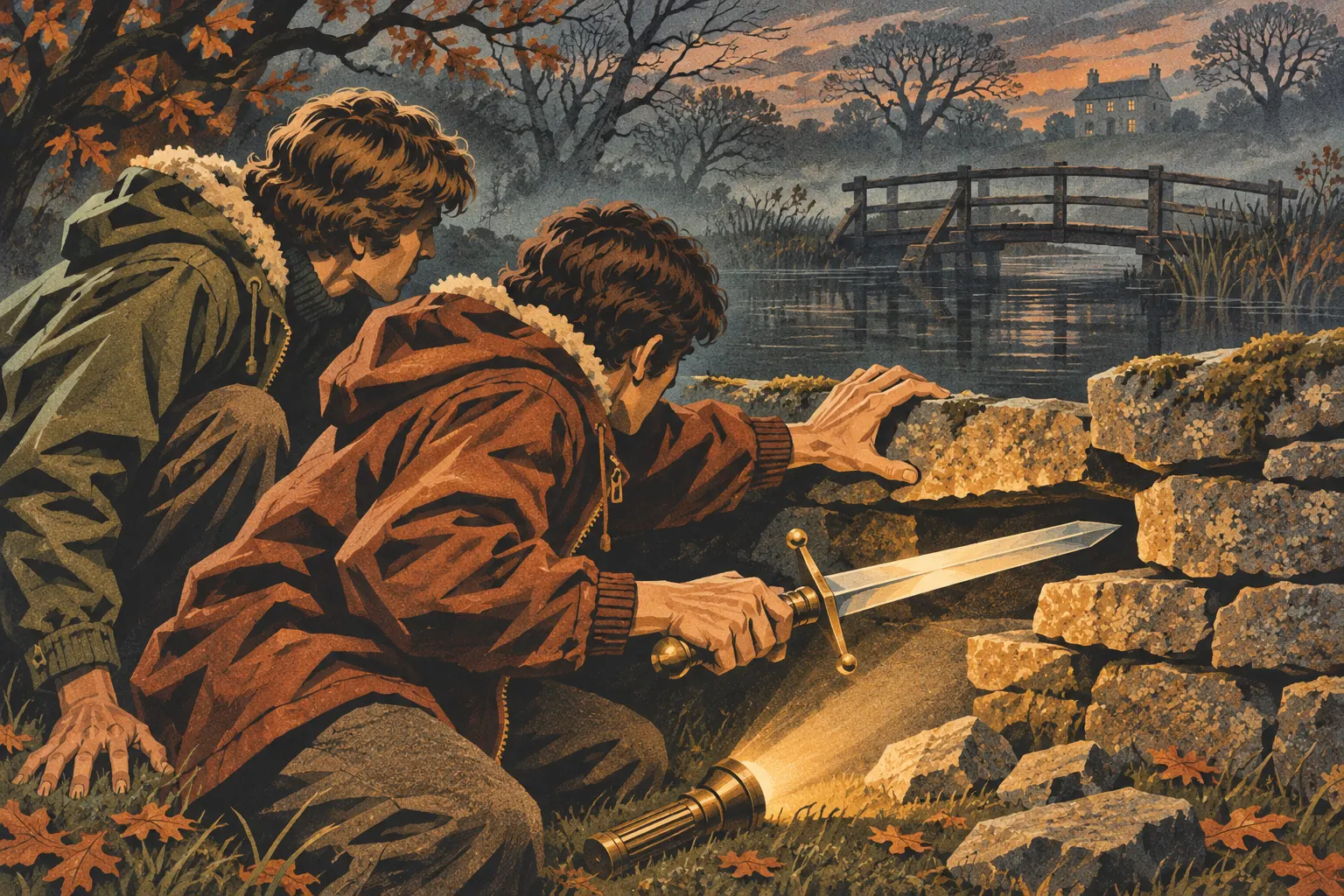
In October 1979 a group of young paranormal researchers in Wolverhampton were told, by a voice under hypnosis, to find a lost jewel of Mary Queen of Scots before Halloween. Within two weeks they had a sword, a brass casket and a green stone. Nobody has ever been able to check how.12
A magazine in a Victorian house
At the end of the 1970s the British paranormal scene ran on enthusiasm, typewriters and very little money. Two of its keenest young members were Graham Phillips, then twenty-six, and his friend Andrew Collins.10 They ran a small investigation group called Parasearch and had launched a newsstand magazine, Strange Phenomena, out of the large Victorian house in Wolverhampton that they shared and that doubled as the magazine's office.1106 Phillips was its founding editor. He had worked as a reporter for BBC radio and would later write a string of books on the Holy Grail and ancient mysteries.10
Parasearch had already done much of the legwork for one of the strangest British UFO books of the period, Alien Contact, by the ufologist Jenny Randles and Paul Whetnall, published in 1981.612 It concerned the Sunderland family of North Wales, whose children reported repeated encounters with alien beings in the middle of the decade, along with poltergeist activity and telepathic messages.11 The family's mother, Marion, and her daughter Gaynor, who was then a teenager, became friends of the Wolverhampton group and two of its most important psychic contacts.61
That matters, because almost everything in the story of the Green Stone came from people who believed themselves to be receiving information by psychic means. The group's other key sensitive was Alan Beard, from Alsager in Cheshire.12
Joanna
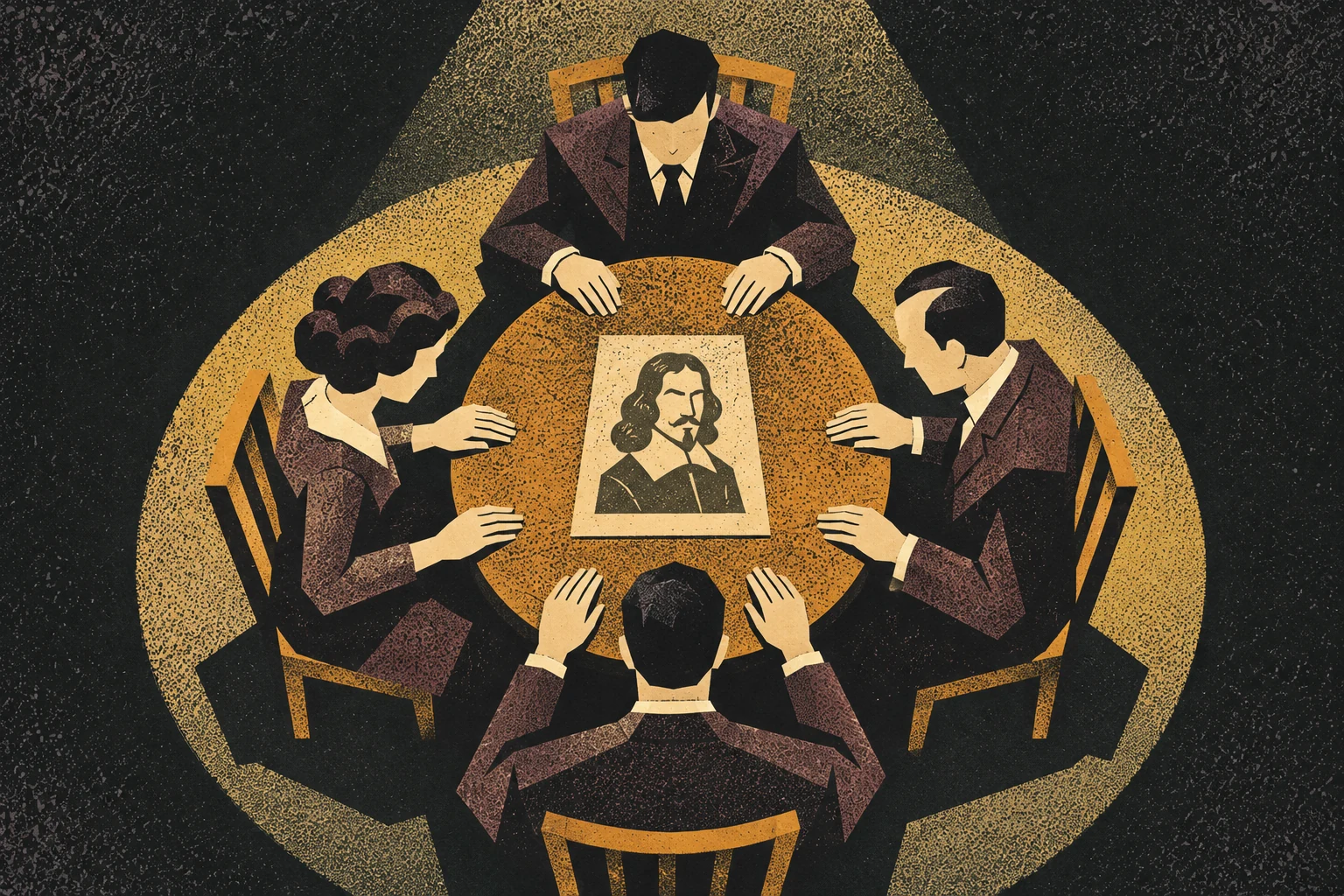
The story, as both Phillips and Collins have told it, began in mid-October 1979. On 15 October Beard had a vision of an oval stone, shrinking from the size of a loaf to the size of an egg, and ending as a cabochon set in a woman's ring, with a stone slab nearby.1 Two days later Collins came home to find Phillips agitated and unsettled. To calm him, Collins hypnotised him, and under hypnosis a second personality spoke through Phillips, a woman who called herself Joanna.1
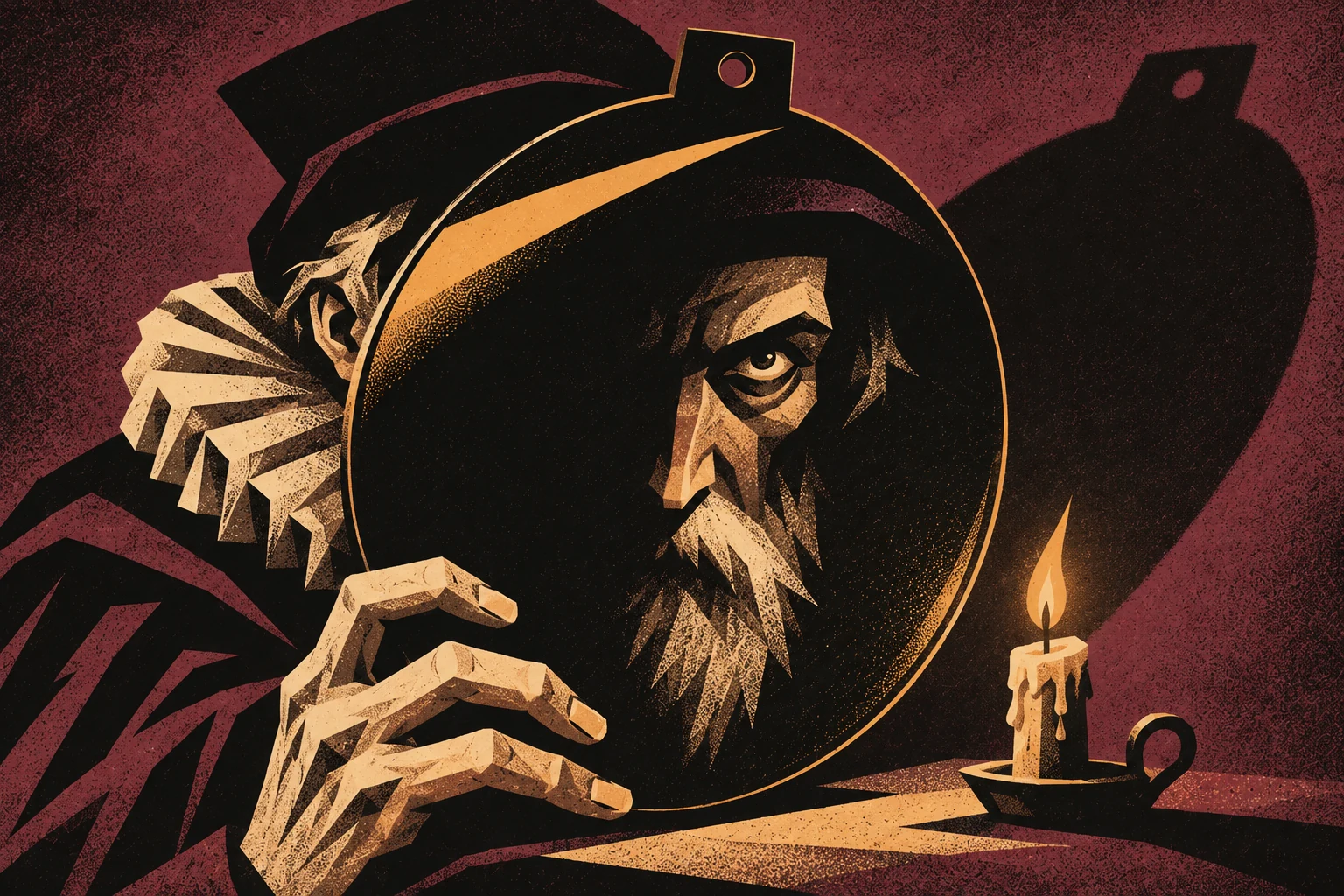
Joanna said that she was an old friend of Phillips from his art-college days, still alive, and that an important item that had once belonged to Mary Queen of Scots had been hidden after the Gunpowder Plot and was waiting to be found.12 She gave its name as Meonia. She also said the quest had to be completed by 31 October, which left the group a fortnight.1 That same morning, Beard reported a second vision of a glowing green stone about the size of a sixpence, floating while people gazed at it, and he soon had a dream of a green stone that would fit into a large ring.12
Joanna's first clue sent the group to Harvington Hall, a moated Elizabethan manor near Kidderminster.1 It was a shrewd choice of setting for a story about hidden Catholic treasure. The house was built by the recusant Humphrey Pakington in the 1580s and contains seven priest holes, four of them around the main staircase, thought to be the work of Nicholas Owen, the Jesuit lay brother who spent his life building hiding places for priests and who was caught at another Worcestershire house after the Gunpowder Plot and died under torture in the Tower of London.1617 Wall paintings of the Nine Worthies at Harvington led the questers' thoughts towards swords, chivalry and King Arthur.1

A sword under a bridge
Beard then telephoned to say that they should look for a sword, which would act as an indicator to the stone.1 On Monday 23 October 1979, by Collins's account, he and Phillips went to Knight's Pool, on the Earl of Coventry's estate near Severn Stoke in Worcestershire, removed stones from behind a dry-stone wall beside a footbridge, and pulled out a short steel sword sealed in resin.15 On its blade were engraved the words Meonia fore Marye. On one side of the crossguard was a damaged image, and on the other what the group identified as the personal arms of Mary Queen of Scots.21
The inscription seemed to tie everything together. According to Joanna, Mary had owned the stone and passed it to Robert Catesby, leader of the Gunpowder Plot, before it was hidden away.1 There was one difficulty. When the sword was examined, it proved to be of nineteenth-century manufacture.1 Later psychic messages, conveniently, explained that the original had been swapped for a Victorian copy, though nobody had mentioned this before the sword was dated. Collins himself has since come to believe the sword is seventeenth century after all.7
There was another difficulty, which belonged to the Earl of Coventry. When Collins sent a copy of his first booklet on the affair to the Earl, whose land the sword had come from, the estate's lawyers wrote back demanding the sword's return and raising the possibility of a prosecution for trespass, theft and criminal damage. The sword was handed over.7 It is now on permanent display, with the story of the quest, at the Tudor House Museum in Upton-upon-Severn.9
Swans and towers
With the deadline approaching, the team spent four days delivering thousands of copies of the second issue of Strange Phenomena and then went back to the hunt. A detour to Meon Hill in Warwickshire yielded nothing.1 On 29 October they took the sword back to Knight's Pool with Gaynor Sunderland, who used it as a divining rod. She pointed it towards a ruined building about two miles away.1
The ruin was Dunstall Castle, which is not a castle at all. It is a sham ruin, built as an eye-catcher on the Earl of Coventry's Croome estate in the 1760s to be seen from the windows of Croome Court. The architect Robert Adam was paid £5 for a drawing of a ruin that could be built, as he put it, at no great expense.1315 (Historic England's listing attributes it instead to the gentleman architect Sanderson Miller, and Collins, recounting the quest, credited Capability Brown.141) Collins, Phillips and Gaynor climbed one of the towers. In the dark they heard wings beating and debris falling, and they retreated. Collins later suggested, reasonably, that it was probably pigeons.1
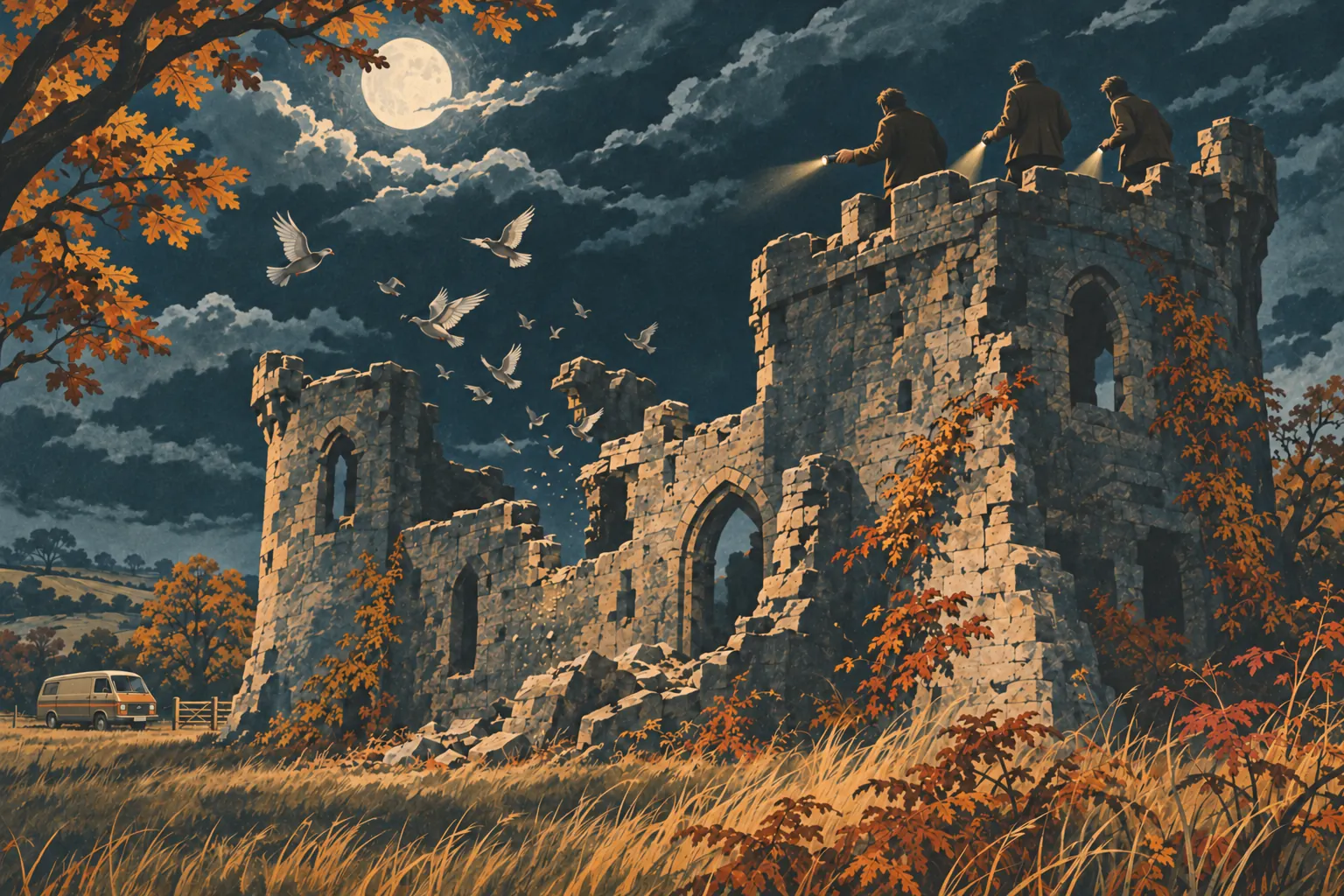
That night the group drove to the Sunderlands' home in Flint, on the North Wales coast. Fred Sunderland narrowed down the search area on an Ordnance Survey map, and Marion recalled that Mary Queen of Scots had embroidered swans with oddly long necks. Phillips then spotted, on the map and inside the search area, a sharp bend in the River Avon called the Swan's Neck.1
Overnight, Gaynor had a dream. She, Phillips and Collins climbed the tower at Dunstall and found a swan with a pouch tied round its neck, which flew out of the tower towards running water, and she understood that this was where the stone would be found.15 Marion and Gaynor had also described an avenue of trees near water and a figure in seventeenth-century dress walking towards a bridge, and two members of the group, Beard and Terry Shotton, had each drawn an arched casket.1
The casket in the field
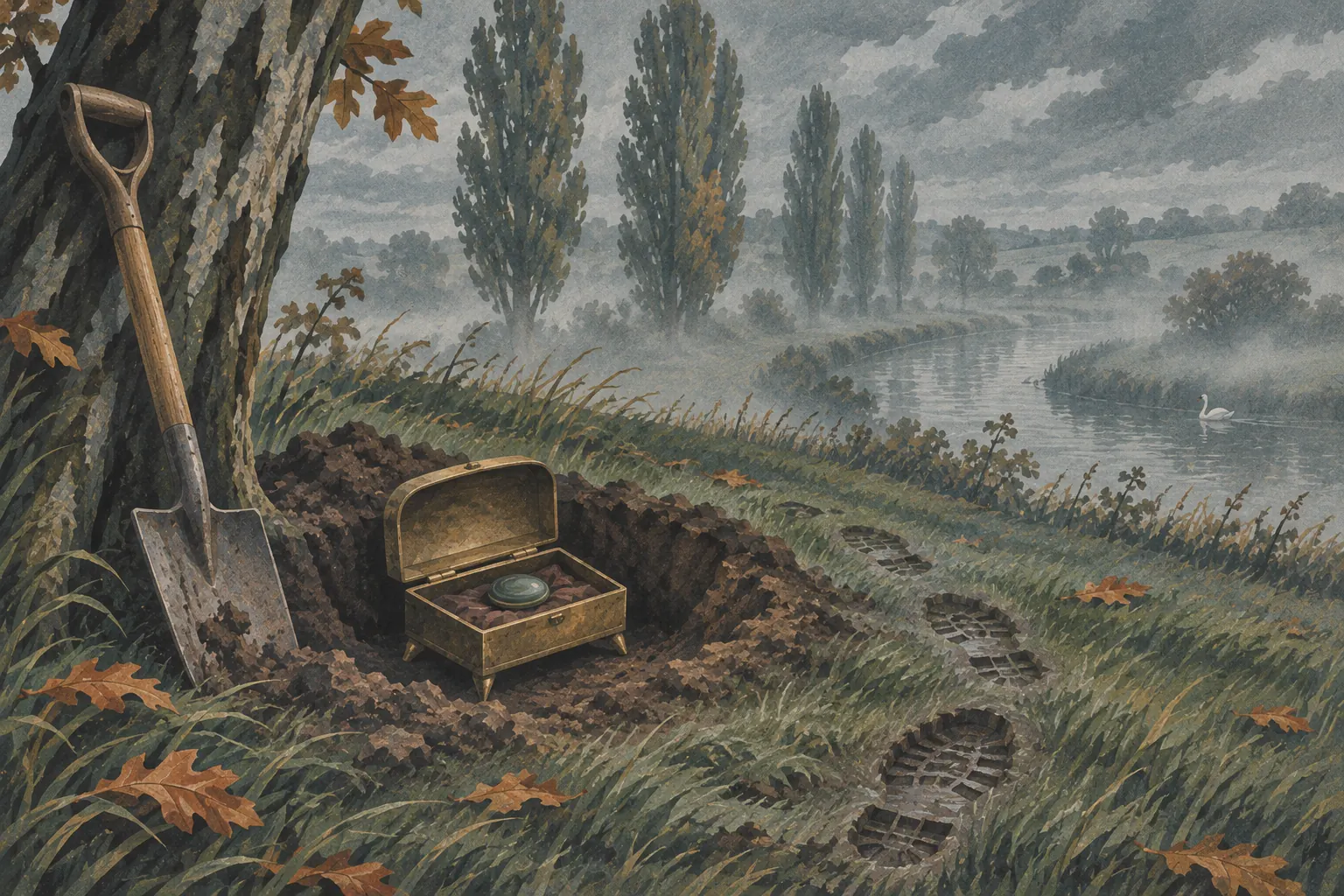
On 30 October, the day before Joanna's deadline, Phillips went to the Swan's Neck alone. The reason given was that a large party would attract attention. He found an avenue of poplars of the kind Marion had described and, after two unsuccessful attempts, dug up a brass casket at shallow depth in a low knoll in a nearby field.1 It had an arched lid and conical legs in a style that looked late seventeenth century. Inside it was a small, polished green cabochon, probably agate, of unknown age.1
The account of what happened next differs depending on who is telling it. Collins's own later version, as one detailed critique has noted, is curious. When the rest of the party reached the Swan's Neck, Phillips had already been there and had soil on his hands. No casket was found while they were present. Phillips insisted that they drive straight to the Sunderlands', overruling a visit to another psychic, and when Collins went upstairs at the Sunderland house he found Phillips showing Gaynor the casket with the stone inside it.7 Collins took this to mean that Phillips had dug it up ahead of the group to keep it from rival occultists. The critic took it to mean something rather simpler.7
One writer who reviewed the questing literature found this the weakest point in the story. The casket and stone were found by one person, with no witnesses, after a chain of clues provided by his friends.5
Phenomena in Wolverhampton
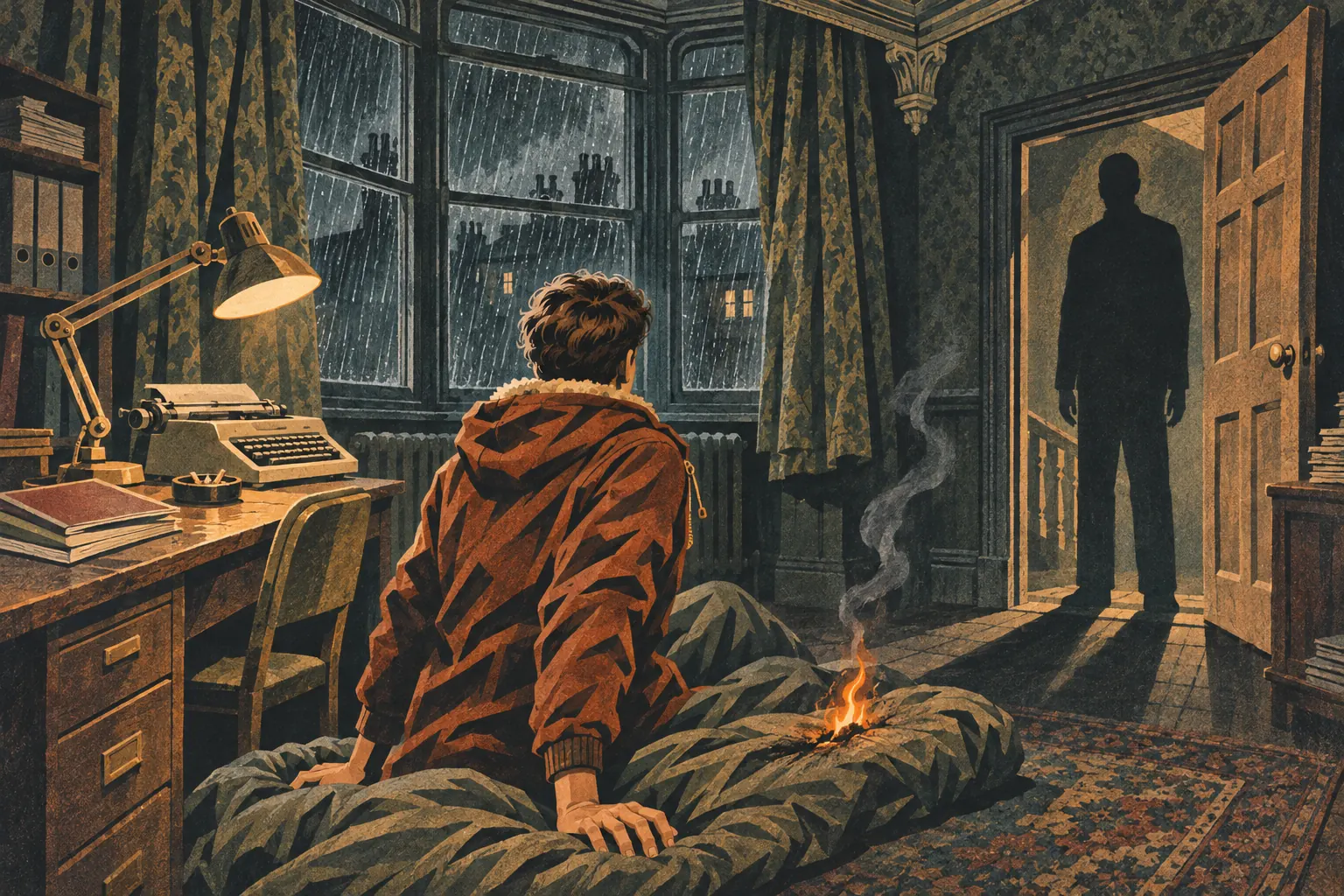
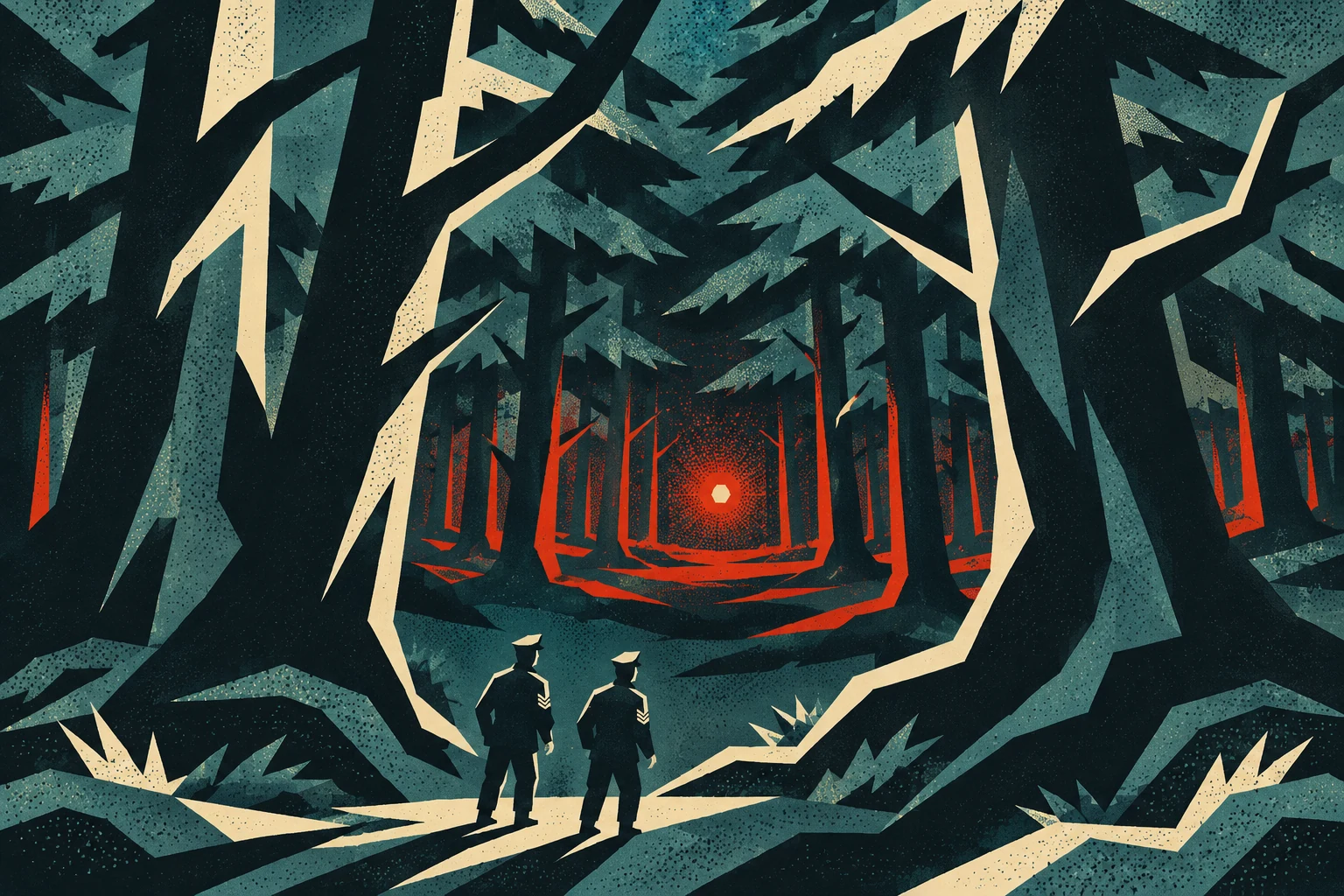
The Green Stone did not settle down quietly in a drawer. According to the account in the book, once the stone was taken to the magazine's offices in the Victorian house in Wolverhampton, the occupants and their visitors began to witness a string of inexplicable events. A dark, faceless figure was seen to appear and vanish. The sleeping bag of a member of the team caught fire, apparently of its own accord, while he slept in the building overnight. And finally, the book claims, nine people witnessed unearthly cries and bright balls of fiery light exploding over a nearby wood when the stone's power was at last unleashed.34
By then, the stone had acquired a mythology to match. The questers came to believe that it had been guarded for centuries by a secret society called the Order of Meonia, whose origins they traced back to the followers of the Egyptian pharaoh Akhenaten, and which had been destroyed in the nineteenth century by dark forces. A rival group of sinister occultists, never identified, was said to be trying to get the stone for itself.67 Collins would later argue that "Meonia" was an anagram of "I am One", and link it to the Hermetic tradition and to the constellation Cygnus, the swan.1
None of the phenomena was photographed, recorded or independently investigated. As one critic put it, the questers seem to have had little interest in proving their experiences to anyone outside the group.65
Books, swords and a falling-out
Phillips and his collaborator Martin Keatman turned the adventure into The Green Stone, published by Neville Spearman in 1983 and in paperback by Grafton the following year.18195 It was written with the narrative drive of a thriller, in the third person, with set-piece confrontations and cliffhangers. One reviewer compared it to a lukewarm Dennis Wheatley.6 Psychic News, the spiritualist weekly, called it one of the most remarkable true stories it had read, and its journalist Alan Cleaver investigated the affair and met Gaynor Sunderland.2120 A sequel, The Eye of Fire, introduced a second, red stone that was said to be the true source of the Order's power, a haunted bell summoning a guardian spirit, and a burglary of a derelict house to get it.6
Collins, meanwhile, published his own versions in a self-published pamphlet, The Sword and the Stone, and then in a series of books on what came to be called psychic questing, including The Black Alchemist and The Seventh Sword, in which six swords turn up and a seventh remains missing.76 Psychic questing became a small craze in the British esoteric world of the 1980s, with groups travelling the countryside on the strength of dreams and visions in search of hidden objects. Its critics noted that the questers were, by their own accounts, frequently trespassing on private land and removing things they found there.65
Phillips and Collins went their separate ways. Phillips moved into alternative history, with books arguing that the Grail was a jar belonging to Mary Magdalene and that the Virgin Mary's tomb was kept secret by the Vatican, and largely dropped the psychic sources.106 Collins moved towards fringe archaeology but came back to questing in later life.6
Where the stone went
The stone itself stayed with the Sunderlands. Marion Sunderland kept the stone and casket for the rest of her life.1 After her death, which sources date to 2005 or 2006 after a long illness, Gaynor and her partner, the ufologist Andy Roberts, offered several items from the quest for sale, including the Green Stone.16 In March 2006 a message on a questing forum announced that the stone and related items had been handed over the previous night to a buyer who wished to remain anonymous.8 Rumours on the same forum claimed they had gone for an astronomical sum to a group of dark magicians.8
The sale opened an old wound. Collins objected publicly, and Phillips was angered when the Eye of Fire, which he had said was destroyed, appeared on the list.6 One forum participant took the opportunity to point out that it was Beard, not the Sunderlands, who had first described both the stone and the sword and who had led the group to the sword's hiding place.8 Nobody publicly knows where the stone is today.1
In 2019, for the fortieth anniversary, Phillips published a revised edition of The Green Stone with four dozen previously unpublished photographs and illustrations, and he and Collins appeared together at a conference in Wolverhampton, followed by a coach tour of Knight's Pool, Dunstall Castle and the Swan's Neck.219
What was the Green Stone?
The honest answer is that the Green Stone was a small piece of polished agate in a brass box, found in a field by Graham Phillips on 30 October 1979. Everything else about it, including its royal history, its secret guardians and its power, came from visions, dreams and the voice of a hypnotised man, and none of it has ever been corroborated by a document, a dating test or an independent witness.56
That leaves three possibilities. The first is the one the questers proposed, that a group of friends really did receive accurate psychic information that led them to buried objects. The second is that one or more members of the group planted the sword and the casket and then guided the others towards them, which the critics consider most likely and which nobody involved has ever admitted.7 The third, more charitable, is that a group of imaginative, isolated young people, steeped in the paranormal and living and working on top of one another, built a shared story out of coincidence, suggestion and wishful interpretation, with someone, somewhere, providing the props.5
Phillips and Collins have never retracted the story. The sword sits in a museum in Upton-upon-Severn, with the arms of a Scottish queen on its crossguard and a Victorian date in its steel, and the stone is in a private collection whose owner nobody knows. For a quest that began with a voice called Joanna, it is a fittingly unfinished ending.
From the archives

Sources21
- What is Meonia? Its philosophy and role in psychic questing Andrew Collins (Bibliotecapleyades.net) · Accessed 2026-11-08
- The Green Stone (2019 edition, ebook preview) Graham Phillips and Martin Keatman · Accessed 2026-11-08
- The Green Stone Graham Phillips and Martin Keatman (publisher's description, Immanion Press 2019) · Accessed 2026-11-08
- The Green Stone Graham Phillips · Accessed 2026-11-08
- The green stone: psychic questing revisited White Dragon · Accessed 2026-11-08
- Phillips & Keatman, questers extraordinaire Fake Geek Boy (review) · Accessed 2026-11-08
- Not as sharp as Occam's razor Fake Geek Boy (review of Andrew Collins, The Seventh Sword) · Accessed 2026-11-08
- The Green Stone has left the building Psychic Questing forum · 2006-03-02 · Accessed 2026-11-08
- The Green Stone 40th anniversary event Andrew Collins · 2019 · Accessed 2026-11-08
- Graham Phillips (writer) Wikipedia · Accessed 2026-11-08
- Alien Contact (review) Goodreads reader review of Randles and Whetnall (1981) · Accessed 2026-11-08
- Jenny Randles Wikipedia · Accessed 2026-11-08
- Dunstall Castle Philip Halling, Geograph (citing Catherine Gordon, The Coventrys of Croome) · Accessed 2026-11-08
- Dunstall Castle (list entry 1082583) Historic England · Accessed 2026-11-08
- The history of Croome Court National Trust · Accessed 2026-11-08
- Harvington Hall Wikipedia (archived copy) · Accessed 2026-11-08
- Priest hole Wikipedia · Accessed 2026-11-08
- The Green Stone (first edition listing) AbeBooks · Accessed 2026-11-08
- The Green Stone, first edition 1983 Dividing Line Books · Accessed 2026-11-08
- A dream of Holywell Alan Cleaver · Accessed 2026-11-08
- The Green Stone (2019 edition) Books-A-Million listing · Accessed 2026-11-08